

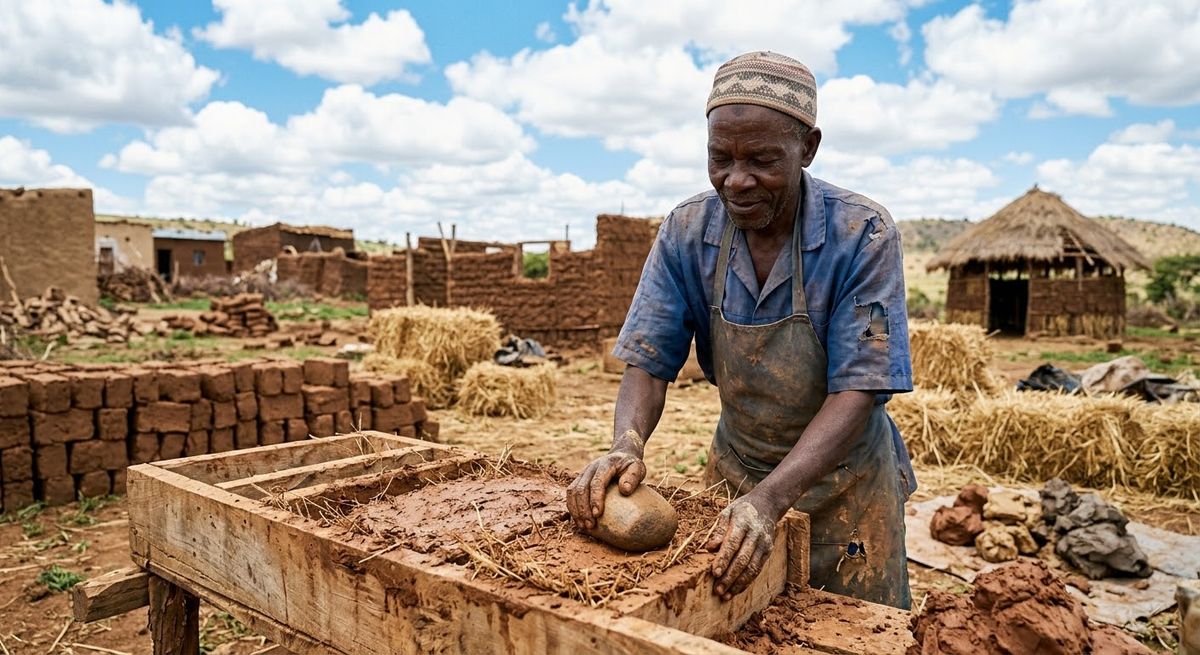
Discover how sourcing local clay and grass in sustainable resort design lowers energy bills, improves guest comfort, and slashes operational costs in 2026.
Earthy textures, cool rustic walls, and soft natural breezes create unforgettable guest experiences across modern eco-resorts. Yet, beneath this tranquil surface, skyrocketing utility bills quietly drain operating budgets every single month. Hospitality operators across global markets face rising grid tariffs, expensive fuel logistics, and escalating cooling demands. Sustainable resort design provides an immediate, battle-tested remedy to break this cycle of high energy expenditure.
By sourcing abundant local clay and grass, resort developers can achieve extraordinary structural thermal performance. Replacing heavy concrete and synthetic boards with harvested organic materials cuts dependence on heavy mechanical HVAC systems. Integrating these age-old natural materials unlocks structural breathability, superior occupant comfort, and major lifecycle savings for your property.
Sourcing Local Clay and Grass for Maximum Thermal Efficiency
Conventional concrete masonry units act like thermal sponges. They trap intense solar radiation throughout the day and radiate heat inward during the night. Research on envelope heat gain index shows standard concrete has a high thermal conductivity; medium-dense blockwork is 0.51W/mK. This rises to 1.33W/mK in dense blocks.
Natural subsoil clay behaves differently. Clay functions as a high-performance thermal mass. According to raw material properties tested by the Earth Building Association of Australia, unfired earth walls maintain a density of 1800 to 2100 kg/m^3 and a specific heat capacity of 1000 J/kgK,absorbing heat slowly during peak daytime hours and delaying heat transfer into guest spaces.
Grass fibers, such as harvested meadow hay, agricultural straw, or manufactured grass insulation panels, supply high thermal resistance. Compressed grass batts trap millions of microscopic air pockets within their fibrous cellular structure. Product testing listed confirms that bio-based grass insulation batts achieve low thermal conductivity ratings around \lambda = 0.040\text{ W/mK}, matching conventional mineral wool. Combining exterior clay plasters with interior compressed grass insulation batts creates a breathable wall assembly.
This natural multi-layer assembly delivers exceptional passive thermal regulation. Exterior clay plaster absorbs radiant heat energy and delays thermal conductivity into the wall core. The dense central layer of compressed grass blocks convective heat transfer entirely. Finally, an interior finish of raw clay plaster actively regulates ambient humidity. Sourcing raw clay subsoil and agricultural grass nearby minimizes material procurement fees, shipping overheads, and embodied carbon emissions.
How Natural Materials Lower Operational Costs in Hospitality & Tourism
Energy expenses are among the largest controllable operational overheads in the global hospitality & tourism sector. Implementing natural insulation strategies improves bottom-line profitability while strengthening green-building credentials and eco-certification scores.
Applying earthen clay plaster to exterior and interior wall faces provides remarkable specific heat capacity. This high thermal storage capacity reduces peak daily cooling loads by 20 to 40%. Installing dense grass fiber batts within stud cavities provides trapped-air insulation that lowers heat transmission by 15 to 25%.
Additionally, technical evaluations confirm that natural plant fibers absorb moisture without losing insulating capacity, stabilizing indoor relative humidity between 10% and 15%. Environmental manufacturing studies show that natural grass insulation requires 70 percent less water during production than standard fiberglass insulation.
Passive thermal control significantly decreases generator diesel consumption and solar battery bank sizing in off-grid luxury resorts. These lower ongoing operational expenses allow property managers to maintain healthier profit margins or offer highly competitive room rates. Explore our sustainability consulting services to model your specific architectural footprint and estimate your project return on investment.
Practical Sourcing, Material Preparation, and Pest Mitigation
Deploying raw natural insulation successfully requires precise material testing and careful surface preparation to guarantee long-term structural durability. Developers must evaluate site soils using simple field tests to determine exact sand, silt, and clay ratios before mixing plasters.
- Harvesting and Sourcing Grass: Collect fully dried agricultural straw or specify pre-treated commercial grass insulation panels, such as Gramitherm natural insulation. Always ensure grass moisture content stays strictly below 15% before wall installation.
- Pest and Mold Control: Thoroughly mix hydrated lime, mineral clay slip, or non-toxic borate salts into raw clay-grass slurries. Acoustic and material testing registered with the European Organization for Technical Assessment shows that dense grass-fiber matrices achieve an acoustic sound absorption rate of up to 0.9 at 1000 Hz, while borate treatments fully prevent mold growth.
- Exterior Moisture Protection: Apply breathable, water-repellent lime washes or silicated plasters over exterior earthen surfaces to shield raw clay from driving rain while keeping the wall assembly fully vapor-open.
These straightforward processing steps protect organic plant fibers from environmental degradation, providing a durable building envelope that lasts for decades without synthetic chemicals.
Frequently Asked Questions
Do grass and clay insulation pose a fire hazard in commercial properties?
When compressed into dense blocks or coated with mineral-rich clay slip and hydrated lime, natural grass fibers char on the outer surface rather than burn freely. Certified lab results under the EN13501-2 European Fire Standard confirm that clay-grass timber frame assemblies routinely achieve fire resistance ratings between 30 and 90 minutes (REI classification).
How does natural insulation impact overall guest satisfaction in Hospitality & Tourism?
Natural clay plasters continuously absorb excess interior humidity and eliminate toxic chemical off-gassing completely. Indoor environmental quality guidelines emphasize that non-toxic, zero-VOC natural wall systems eliminate indoor pollutants, delivering quieter, healthier, and allergen-free guest suites that promote restorative sleep.
Lower Your Resort’s Utility Bills Today
Ready to transform your resort’s energy performance and eliminate excessive cooling bills? Our team helps developers, architects, and hoteliers design high-yield, eco-friendly properties using proven natural building materials.
Book a comprehensive design consultation this month and receive a guaranteed roadmap to reduce your project's HVAC energy demand by 20 percent.
Call: +234 806 496 8725
Visit our website:www.thisisbusiness360.com