
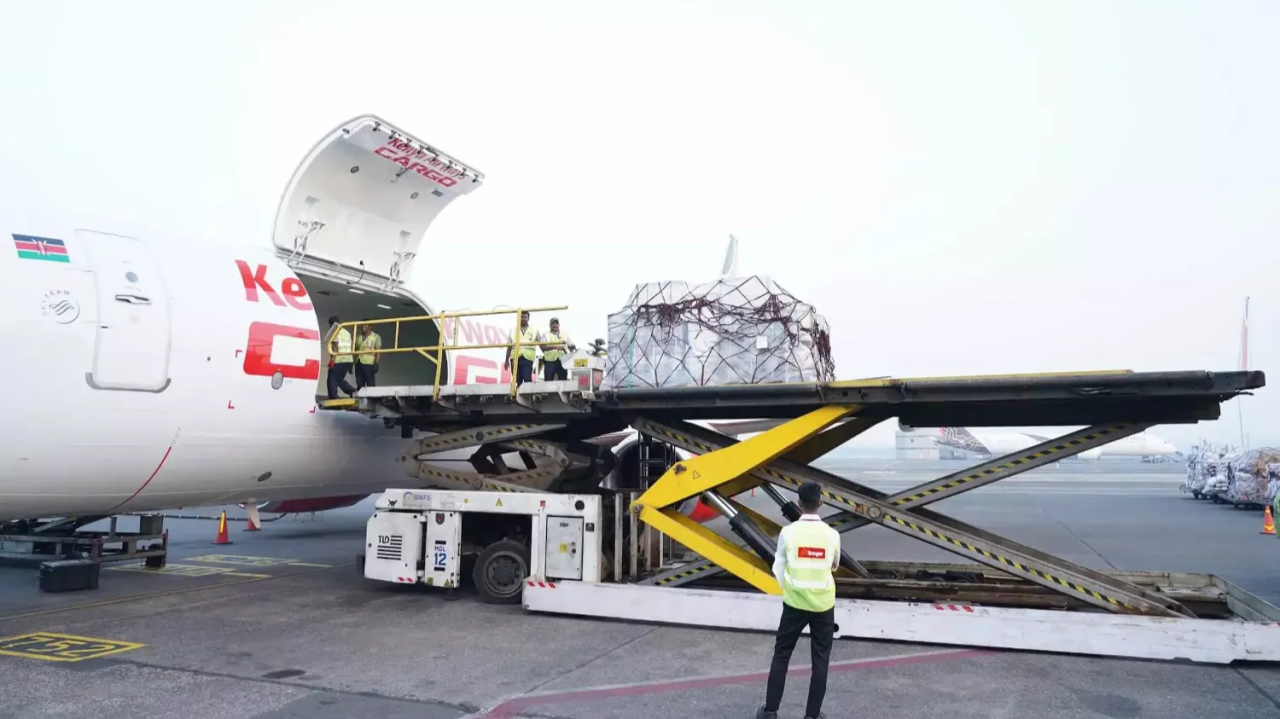
The Africa–Asia air cargo corridor recorded a 41.6 per cent year-on-year surge in freight volumes in January 2026, making it the fastest-growing trade lane globally and extending a growth streak to seven consecutive months, according to data released Monday by the International Air Transport Association.
The explosive growth on the Africa–Asia route significantly outpaced other major corridors and contributed to a robust start to the year for global air cargo, which posted 5.6% year-on-year growth overall. International operations expanded even faster at 7.2%, while capacity grew at a more modest 3.6 %, pushing the global cargo load factor up 0.9 percentage points to 45.1%.
African carriers led all regions with an 18.2% year-on-year increase in demand, the strongest regional growth globally, while capacity increased 6.5%. The performance underscores a significant shift in global airfreight flows as African trade with Asia continues to deepen across manufacturing, consumer goods, e-commerce, and resource exports.
Beyond the Africa–Asia surge, several other major trade lanes posted strong figures in January. The Europe–Asia route increased 15.2 per cent, extending its growth streak to an extraordinary 35 consecutive months. Within Asia, volumes grew 14.3%, marking 27 consecutive months of growth. The Middle East–Asia route increased 12.9%, while the Europe–Middle East route grew 10.2%.
However, not all corridors expanded. The Asia–North America route declined 0.6 per cent year-on-year, reflecting ongoing pressures from evolving US trade policies and tariff uncertainties. Europe–North America rose 3.8%, marking 24 consecutive months of growth but at a slower pace than other major lanes.
At the regional level, the divide was sharp. While Africa, the Middle East, Asia-Pacific, and Europe all posted growth above the global average, carriers in the Americas registered aggregate contractions for the sixth consecutive month. North American carriers saw demand fall 0.5%, while Latin American and Caribbean carriers recorded a 2.0% decline, the weakest performance of all regions.
The 41.6% jump in Africa–Asia cargo reflects several converging factors. First, China and other Asian economies have significantly deepened trade and investment ties across Africa over the past decade, creating two-way flows of manufactured goods, raw materials, and consumer products.
Second, African e-commerce platforms increasingly source inventory from Asian suppliers, driving demand for air freight to meet delivery timelines. Third, African resource exports, particularly perishables, high-value agricultural goods, and specialised minerals, are finding growing markets in Asia.
The growth also comes at a time when alternative trade corridors are under pressure. US tariffs and policy uncertainty have dampened the traditionally dominant Asia–North America lane, prompting logistics operators to reconfigure networks and shift capacity toward faster-growing regions, including Africa, the Middle East, and intra-Asia routes.
Despite the strong January figures, IATA Director General Willie Walsh cautioned that air cargo resilience will face fresh tests in the coming months. “The demand for air cargo had a robust start to 2026, recording 5.6% year-on-year growth in January,” Walsh said.
“However, the resilience of air cargo will continue to be tested in the coming months. In addition to the long-running uncertainties of evolving US trade policies, the outbreak of hostilities in the Middle East will both weigh heavily on global supply chains.”
Walsh noted that addressing these challenges will be a key focus at IATA’s World Cargo Symposium in Lima, Peru, scheduled for March 10–12, 2026, where strengthening air cargo’s adaptability and efficiency through digitalization will be central themes.
Several factors supported January’s performance. Global goods trade grew 4.9% year-on-year in December 2025, while jet fuel prices declined 6.5% year-on-year in January. Manufacturing sentiment also strengthened, with the global Purchasing Managers’ Index rising to 51.8 above the 50-point expansion threshold and its highest level in over 18 months.
While Africa still accounts for just 2.1 per cent of total global cargo traffic by market share, the continent’s growth trajectory is outpacing every other region. The 18.2% regional demand increase in January follows a pattern of sustained double-digit gains that began in mid-2024, positioning African carriers as a key growth driver in a polarised global market.
For airlines and logistics operators, the Africa–Asia corridor represents both a strategic opportunity and a capacity challenge. Infrastructure constraints, regulatory fragmentation, and limited belly-hold capacity on passenger flights in some African markets continue to limit the speed at which cargo volumes can scale.
Still, the 41.6% growth rate signals that demand is far outstripping current capacity, creating both opportunity and urgency for carriers willing to commit resources to the corridor. As US–Asia trade stagnates and intra-European growth moderates, Africa’s integration into Asian supply chains may be one of the defining shifts in global air cargo over the next decade.
Stay Informed: Visit our website for Breaking News and Insights.