
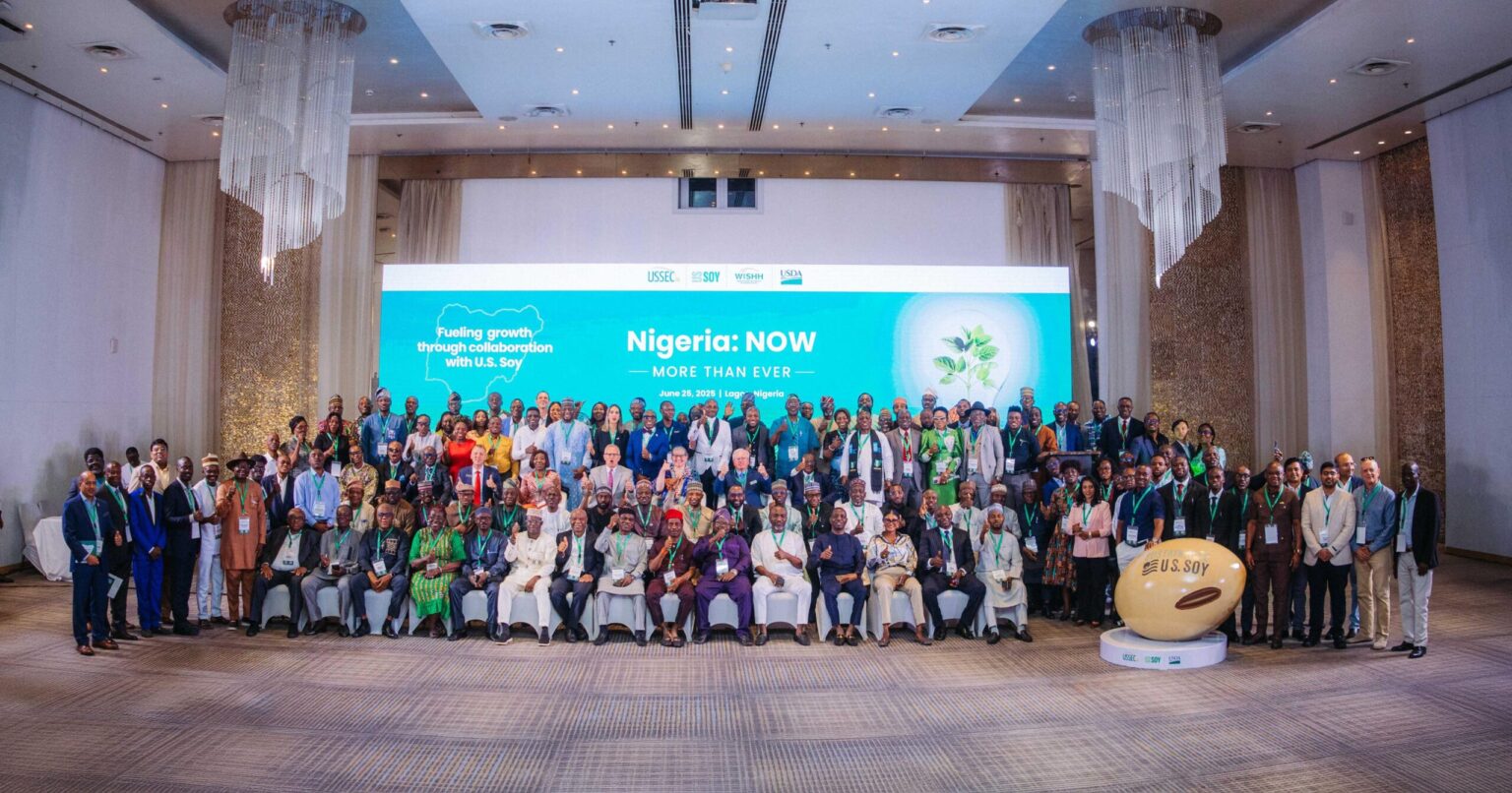
The U.S. Soybean Export Council has declared Nigeria its top strategic market in Sub-Saharan Africa and renewed its push to address the country's widening animal protein deficit through knowledge transfer, technology adoption and workforce training rather than direct competition with local producers, as the two countries rebuild a trade relationship that was dormant for six years before reviving in early 2025.
Nigeria imported 62,000 metric tonnes of U.S. soybeans in early 2025 after a six-year break, a resumption that USSEC executives described at the organisation's Nigeria: Now Conference 2026 in Lagos as confirmation that the partnership is moving from diplomacy to commerce. Brent Babb, Executive Director of the Soy Excellence Centre and Sub-Saharan Africa for USSEC, said Nigeria's demographics made it impossible to ignore, noting that over 60% of the U.S. soybean crop is exported worldwide and that Sub-Saharan Africa, with Nigeria as the regional leader, represents a growing share of that opportunity.
Population growth is driving demand, yet per capita protein consumption remains low, a gap Babb described as a significant opportunity. "Nigeria grows soybeans, but as demand for consumption rises, more soybeans will need to be imported. Our role is to complement Nigeria," he said.
The commercial argument USSEC is making goes beyond volume. Babb said the U.S. soy's edge for Nigerian feed millers lies in consistent digestibility and energy value, which reduce the need to over-formulate feed rations and lower input costs across poultry, livestock, and aquaculture operations. The council also works with producers on feed formulation, materials handling and biosecurity through its Soy Excellence Centre training platform. Over 1,200 Nigerians graduated from SEC courses this year alone, and more than 5,000 have participated since the programme launched. One feed mill increased pellet production by 15-20% while cutting costs by 10% after adopting full-fat soy techniques.
The backdrop, however, is more complicated than the conference framing suggests. Nigeria's soybean exports declined sharply in 2025 despite broader non-oil export growth, with raw soybeans falling 62.08% year-on-year and soybean flour and meals declining 54.91%. The government unveiled a National Soybean Production and Expansion Policy in July 2025 targeting ₦3.9 trillion in annual revenue and one million jobs across 22 states. Still, the policy's first year coincided with one of the sharpest declines in soybean export earnings on record.
USSEC executives identified financing constraints, inflation, and inconsistent value chain supplies as key challenges limiting growth in Nigeria's protein sector, with Babb describing financing as often the biggest single obstacle. "You need quality day-old chicks, reliable soybean supplies for crushers to run at high capacity, and consumer demand that can withstand inflation," he said.
The structural tension at the centre of the USSEC pitch is one Nigeria will need to navigate carefully. Importing 62,000 tonnes of U.S. soybeans and building a domestic soybean sector capable of generating ₦3.9 trillion in annual revenue are not obviously compatible ambitions, and the government has not yet explained how it plans to reconcile them. Babb's framing, in which local production and imports can grow together, is the optimistic version. Whether the regulatory environment, foreign exchange availability, and value chain consistency will allow both to happen simultaneously remains the question that a conference in Lagos cannot answer.
Stay Informed: Visit our website for Breaking News, Intelligence, and Insight.