
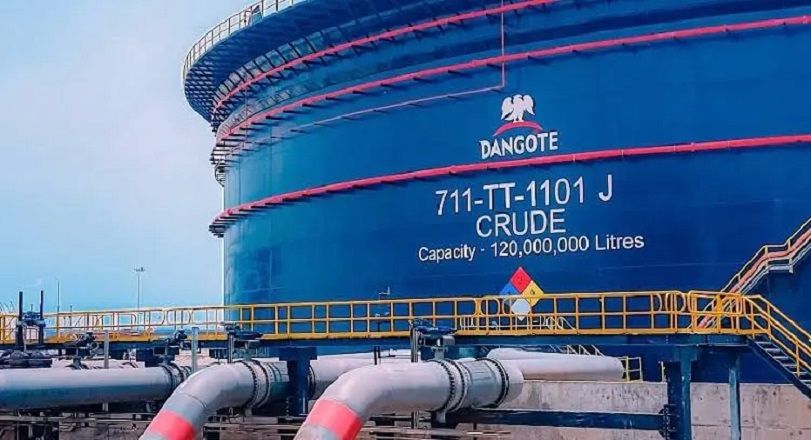
The refinery that took 11 years and $20 billion to build has just proven that what it was designed to do is not the ceiling, it is the floor.
Dangote Petroleum Refinery & Petrochemicals has increased its crude oil processing capacity to 700,000 barrels per day (bpd) following a successful performance test conducted by its Process Licensors, surpassing its nameplate capacity of 650,000 bpd and further cementing its position as the world's largest single-train petroleum refinery.
The 50,000 bpd over-performance is not incidental; it is engineering proof. The achievement demonstrates the refinery's ability to process additional feedstock while optimising performance across its production units, underlining both the facility's engineering capability and its operational efficiency under full commercial conditions.
But 700,000 bpd is just the opening statement in a far more audacious plan. Dangote Refinery CEO David Bird confirmed that construction is already underway on a second crude processing unit at the Lekki site outside Lagos, with 700,000 bpd of fully complex additional refining capacity targeted to come on stream by the end of 2028. Long-lead equipment has already been procured, and construction contracts are being finalised. When complete, the complex will process approximately 1.4 million bpd, a combined capacity that would make it one of the largest refining complexes anywhere in the world.
Devakumar Edwin, Vice President for Oil and Gas at Dangote Industries Limited, set the stakes without ambiguity: "The refinery's growth trajectory reflects a deliberate move toward continental and global refining dominance, not just domestic supply sufficiency."
The expansion is expected to deliver substantial economic benefits, including job creation, increased industrial activity, and improved trade balances, while strengthening downstream manufacturing through a guaranteed supply of LPG, polypropylene used in packaging, and Linear Alkylbenzene (LAB), a key raw material in detergent manufacturing, and establishing integrated value chains across multiple industrial sectors.
The commercial context amplifying this milestone is the Middle East war. At its peak this spring, the refinery was exporting roughly 100,000 bpd of jet fuel, with Europe absorbing about half of those volumes, while Bird confirmed plans to expand the company's trading business alongside the refinery buildout.
If the second unit comes on stream as planned, the total Dangote complex at 1.4 million bpd would rival the world's largest refining site, the Jamnagar complex in India operated by Reliance Industries, which processes approximately 1.24 million bpd.
Nigeria spent decades exporting crude and importing petrol processed by other countries from its own oil. The 700,000 bpd milestone achieved above design capacity, with a doubling plan already under construction, is the most concrete proof yet that the era of that dependency is ending. By 2028, Lekki may be the address of the world's largest refinery.
Stay Informed: Visit our website for Breaking News, Intelligence, and Insight