
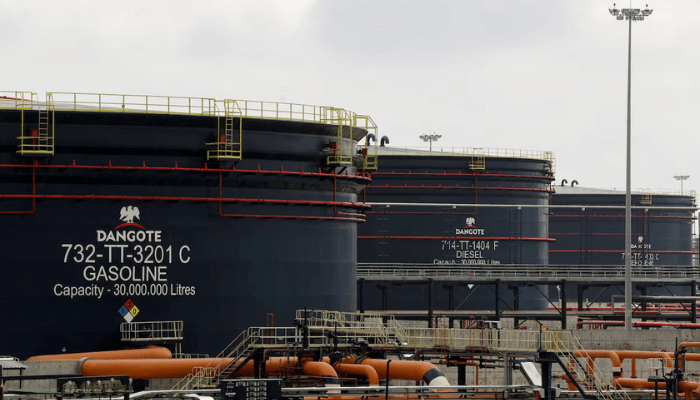
The world's largest single-train refinery has just made a purchase that no one anticipated when it was designed to run almost entirely on Nigerian crude.
The Dangote Petroleum Refinery has purchased two cargoes of crude oil from the United Arab Emirates, marking its first-ever procurement of Middle Eastern crude as it expands its feedstock sources amid persistent domestic supply constraints. According to S&P Global Commodity Insights, the two cargoes will be the first sourced by the 700,000-barrels-per-day refinery from any Middle Eastern supplier, signalling a shift from its traditional reliance on Nigerian, African, and United States crude grades.
The timing of the purchase is directly linked to the Iran ceasefire. The deals follow an exodus of tankers from the Gulf after the US and Iran struck an interim peace agreement guaranteeing safe passage through the Strait of Hormuz, restoring global confidence in Middle Eastern crude shipments. Benchmark Murban crude prices have fallen sharply following the restoration of stability in the region, trading at around $66.40 per barrel on June 26, nearly $6 below pre-conflict levels, making UAE grades commercially attractive for the first time.
The UAE cargoes will likely include grades from ADNOC's portfolio. The Abu Dhabi National Oil Company, which produces most of the UAE's crude, declined to comment on the transaction. Its main export grades are the light sour Murban, Das Blend, and Umm Lulu, with sulphur content of 0.7% to 1.14%, as well as the medium sour Upper Zakum.
The purchase reflects a deliberate strategic evolution at Dangote rather than crisis management. CEO David Bird has been transparent about the refinery's ambitions to broaden its crude diet. Bird has emphasised plans to develop Dangote into a fully merchant refining model and would like to more than triple the number of crudes it can process from around 40 today. In 2026, the refinery will have already imported cargoes of Angola's Cabinda and Saxi Batuque crudes, Ghana's Jubilee crude, and for the first time, Libyan and Guyanese supplies, all of the light sweet or medium sweet variety. He added earlier this year: "We definitely want to heavy up the barrel."
The domestic supply constraint behind the international sourcing push is structural and well-documented. The refinery was designed primarily to process Nigeria's light sweet crude. However, the arrangement has faced challenges due to inadequate crude availability and operational issues at export terminals, compelling the company to seek additional crude sources outside Nigeria. Shipping data show that around 70% of the refinery's crude imports in 2025 originated from Nigeria, while approximately 24% came from the United States.
The scale of the refinery's appetite makes the feedstock challenge acute. The refinery needs to fund roughly $1.0 billion to $1.5 billion of crude purchases every single month at recent oil prices, requiring reliable access to several billion dollars in trade finance lines at any given moment.
The refinery's expansion plans will further increase its crude requirements, with Dangote planning to double processing capacity to 1.4 million barrels per day by the end of 2028, a level that would enable it to process about 80% of Nigeria's recent crude oil production in a single day. At that scale, sourcing crude from Nigeria alone was never going to be sufficient. The UAE purchase is not a workaround. It is the beginning of a global crude strategy for a refinery that is rapidly outgrowing its original feedstock geography.
Stay Informed: Visit our website for Breaking News, Intelligence, and Insight.