
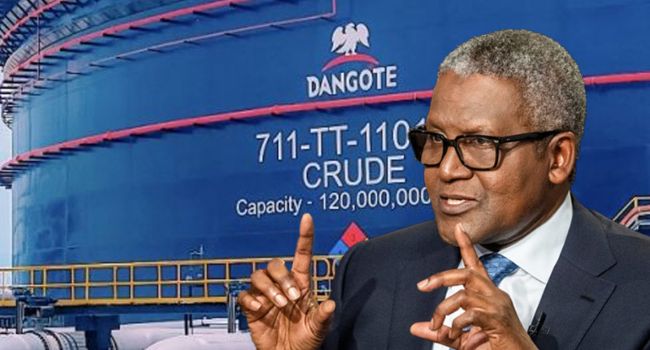
Dangote Petroleum Refinery has resumed naira-denominated gantry loading of Premium Motor Spirit after a week-long suspension that rattled Nigeria's downstream fuel market, but the return to local currency transactions comes at a cost: the refinery has raised its ex-depot price by 13.02% to ₦1,215 per litre from the previous ₦1,075 per litre, effective Wednesday, July 22, 2026.
The suspension had tightened supply and pushed ex-depot petrol prices in Lagos to as high as ₦1,275 per litre at third-party depots during the week the refinery's gantry was offline. Before halting product loading, Dangote Refinery attributed the suspension to challenges in securing adequate crude oil supplies under the Federal Government's naira-for-crude initiative, prompting its temporary switch to dollar-denominated sales.
The naira sales halt had been tied to strains in the crude-for-naira arrangement, under which local refiners are meant to receive crude oil in local currency to ease dollar demand and stabilise pump prices. Dangote had said its naira-denominated petroleum product sales had outpaced the naira-denominated crude allocations it was actually receiving from the state oil company, forcing a temporary switch to dollar pricing to match its procurement costs.
The crude oil arithmetic behind the price increase is straightforward and brutal. Market data on Wednesday showed Brent crude climbing 3.18% to $93.90 per barrel while WTI rose 2.74% to $86.65 per barrel, levels that reflect the renewed Strait of Hormuz tensions following Trump's ceasefire reversal with Iran last week. The refinery's coastal loading price was simultaneously raised from ₦1,441,575 per metric tonne to ₦1,602,495 per metric tonne, a 11.16% increase that signals the full supply chain repricing flowing from higher global crude costs.
The reversal to naira removes a source of foreign exchange exposure that had complicated planning and squeezed margins industry-wide, and IPMAN had pressed the government to resolve the naira-for-crude impasse to prevent further disruption. Checks indicated that the new gantry price of ₦1,215 per litre remains lower than the cost of imported products, with some depot owners pricing imported petrol at ₦1,274 per litre, while some retail stations in Lagos were already dispensing at above ₦1,300 per litre.
The sequence of events in Nigeria's downstream market over the past two months tells a coherent and uncomfortable story. Brent fell from its March peak above $126 per barrel, Dangote cut ex-depot prices four times in quick succession down to ₦1,075, pump prices briefly eased, and talk of a return to ₦800 per litre spread widely. Then Trump declared the ceasefire over, crude reversed, the naira-for-crude scheme ran into execution problems, Dangote suspended naira sales, supply tightened, depots repriced higher, and the refinery has now resumed at ₦1,215, a price ₦415 per litre above where petrol stood before the Hormuz crisis began. The mechanism that was supposed to shield Nigeria from global oil price volatility through domestic refining has instead demonstrated exactly how exposed the country remains to every turn in the geopolitical weather, because the crude that feeds the refinery is still priced in dollars on a global market that answers to no one in Abuja.
Stay Informed: Visit our website for Breaking News, Intelligence, and Insight.