
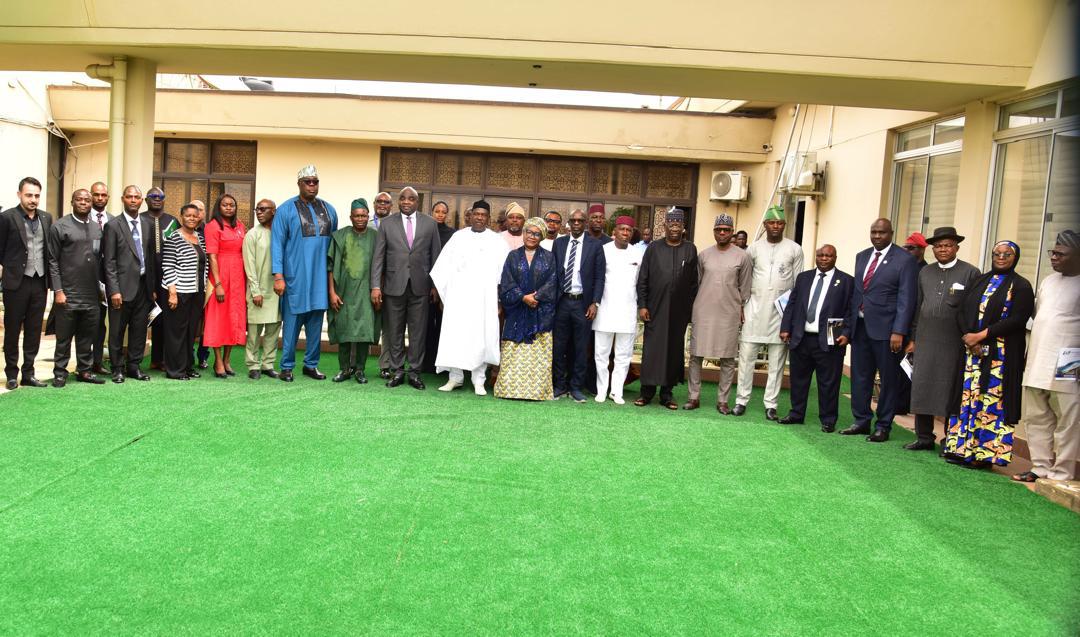
An inter-agency committee was inaugurated to vet the De-Sadel consortium’s proposal for a 4,000km high-speed rail network integrating gas development and power generation, with SGF warning that the project was “too large and important” to fast-track.
The federal government Thursday inaugurated a multi-agency technical committee to conduct rigorous due diligence on a proposed $200 billion Integrated Gas, Power and High-Speed Rail Project submitted by De-Sadel Nigeria Limited in partnership with China Liancai Petroleum Investment Holdings Limited, with the Secretary to the Government of the Federation warning the initiative is “too large and too important” to be rushed without comprehensive vetting.
Senator George Akume, who inaugurated the committee, said the massive infrastructure proposal unveiled in August 2025 under President Bola Tinubu’s Renewed Hope Agenda is envisioned as a multi-phase programme integrating gas development, power generation and transmission, and construction of a 4,000-kilometre high-speed rail network connecting major economic corridors, including Lagos, Abuja, Kaduna, Kano, and Port Harcourt. The project aims to leverage Nigeria’s gas reserves, estimated at over 200 trillion cubic feet, to support power generation and electrified rail systems while reducing travel times by 75%.
The committee, chaired by the Permanent Secretary of the Political and Economic Affairs Office, draws membership from critical ministries including Transportation, Petroleum Resources, Finance, Justice, and Environment, alongside key agencies such as the Central Bank of Nigeria, Nigeria Financial Intelligence Unit, Economic and Financial Crimes Commission, National Intelligence Agency, Office of the National Security Adviser, and Debt Management Office. Akume disclosed that preliminary feedback had been obtained from security, regulatory, and financial intelligence institutions regarding funding arrangements and corporate profiles of consortium members, necessitating a unified technical review.
The committee’s mandate includes verifying proof of funds, assessing financial and sovereign risk exposure, evaluating the proposed oil-and-gas-backed financing model, including any asset divestment plans, and conducting technical due diligence on the consortium and its engineering partners, notably China Railway Group Limited and China Railway Engineering Corporation. The panel will also review compliance with Public-Private Partnership requirements, including risk allocation mechanisms, environmental and social impact considerations, and resettlement frameworks.
Managing Director of De-Sadel Nigeria Limited, Samuel Ukoh, described the initiative as a “national infrastructure reset,” disclosing that the first phase would cover approximately 1,700 kilometres linking Lagos, Abuja, Kano, and Port Harcourt across more than 20 states, with trains designed for speeds up to 350 kilometres per hour. He said travel time between Lagos and Abuja could be reduced to about two and a half hours, while Abuja-Kaduna trips would take under 30 minutes. The rail infrastructure would be constructed largely on elevated bridges with integrated fibre-optic and power transmission lines embedded within the same structure.
Ukoh said the project would generate over two million jobs while significantly boosting gas and power sectors, explaining that the consortium would invest alongside multinational oil companies to increase gas production rather than waiting years to develop new fields. Akume called on committee members to execute their duties with professionalism, objectivity, and patriotism, ensuring due diligence and compliance with international best practices before submitting evidence-based recommendations to guide the government’s final decision.
Stay Informed: Visit our website for Breaking News, Intelligence, and Insights