
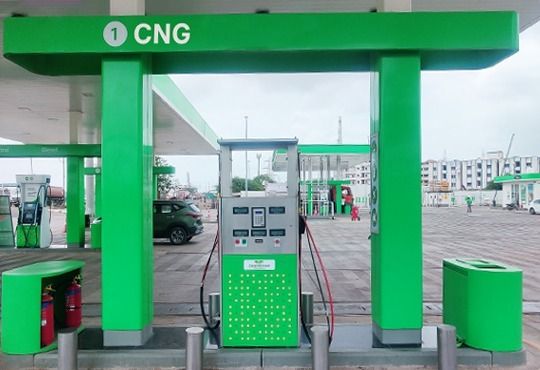
Nigeria targets 1 million CNG vehicles by 2027, but N300,000-N1.8 million conversion fees, limited refueling stations outside major cities, and safety concerns slow adoption despite 50% cost savings.
Soaring fuel prices are driving Nigerian commercial drivers toward compressed natural gas as a cheaper alternative that could cut transport costs by up to 50%, but analysts warn that high upfront conversion fees ranging from N300,000 to N1.8 million, limited refueling infrastructure concentrated in major cities, and lingering safety concerns are slowing progress toward the government’s ambitious target of converting 1 million vehicles by 2027.
The Presidential Compressed Natural Gas Initiative, launched in 2023 after President Bola Tinubu declared an end to the long-running petrol subsidy, promotes CNG as a lower-cost, lower-emission alternative for vehicles, particularly commercial transport. Officials say switching to CNG can reduce transport fuel costs by 50% while cutting particulate emissions and local air pollution, positioning the policy as part of Nigeria’s broader climate commitments, including its pledge to reach net-zero emissions by 2060.
Research from Delta State University of Science and Technology and Federal University of Petroleum Resources Effurun found that CNG vehicles reduce carbon dioxide emissions by 29%, nitrogen oxide emissions by 70%, and particulate matter emissions by 80%, with reductions estimated to prevent hundreds of premature deaths and thousands of hospital visits annually. Victor Ejechi, head of Nigeria insights at SBM Intelligence, said CNG offers a cleaner alternative within the fossil-fuel spectrum, producing fewer particulates, less sulphur, and lower local air pollution that matters in dense urban centers.
However, significant barriers hinder widespread adoption. Conversion costs ranging from N300,000 for 1.6-litre engines to N600,000 for larger vehicles, with tricycles costing N100,000-N200,000 and lorries up to N1.8 million, remain prohibitively expensive for many low-income operators who lack access to credit or subsidies. Nigeria currently has only 131 CNG conversion stations across states, including Lagos, Kaduna, Ogun, Oyo, and Abuja, insufficient to cover the entire country and are concentrated primarily in major urban areas, leaving rural and semi-urban communities with limited access.
Emmanuel Kilaso, founder of the Securecycle Environmental and Climate Change Initiative, said rural communities face impractical adoption conditions, while informal transport workers, including tricycle and motorcycle operators, encounter structural barriers, including a lack of credit, technical support, and regulated conversion systems. Safety concerns also persist among drivers wary of CNG cylinder explosions, compounded by low public awareness, as many Nigerians remain more familiar with petrol and diesel.
The government has introduced subsidized vehicle retrofits for commercial cars, buses, and tricycles operating on interstate and intrastate routes, alongside free conversion programs for certain commercial vehicles. However, bureaucratic delays, inadequate refueling infrastructure along major routes, and resistance from transport unions continue to hamper progress. Nigeria, with proven gas reserves of 206.53 trillion cubic feet as of 2021, remains well-positioned to leverage abundant natural gas resources, yet full CNG potential remains largely untapped as the nation struggles to balance affordability gains against infrastructure and safety challenges.
Stay Informed: Visit our website for Breaking News, Intelligence, and Insights