
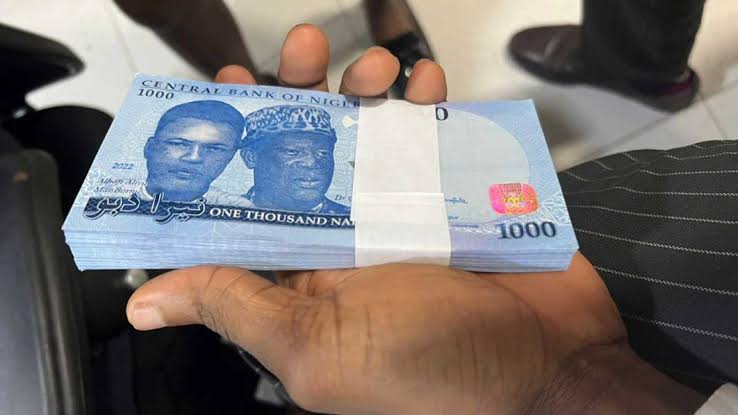
Cash held outside Nigeria's banking system declined to ₦4.92 trillion in June 2026, its lowest level in seven months and the first time the ratio of currency outside banks has fallen below 90% of total currency in circulation in eleven months, according to the latest Money and Credit Statistics released by the Central Bank of Nigeria.
Currency outside banks dropped by ₦485.80 billion, or 8.98%, from ₦5.41 trillion in December 2025, with June marking the lowest reading since November 2025, when cash outside banks stood at ₦4.91 trillion. The June figure represents a month-on-month decline of ₦271 billion from ₦5.19 trillion in May, while total currency in circulation fell by ₦167 billion over the same period to ₦5.52 trillion from ₦5.69 trillion.
The ratio of cash outside banks to total currency in circulation declined to 89.1% in June, falling below the 90% mark for the first time in eleven months as more physical currency flowed back into the formal banking system. The shift, while incremental, is meaningful in the Nigerian context, where the persistence of cash-dominant transactions has long complicated the CBN's ability to manage monetary policy and where digital payment adoption has been a strategic priority for the apex bank.
Bank reserves increased by ₦233.23 billion, or 0.69%, to ₦33.996 trillion from ₦33.763 trillion in May, suggesting that at least part of the cash returning to the formal system is being held as reserves within deposit money banks rather than being immediately deployed as credit, consistent with a banking sector that remains cautious about extending loans in a high-rate environment.
The trend also needs to be read in the context of the longer arc. In April 2026, currency outside banks accounted for 90.03% of total currency in circulation, down from 90.87% in February and 94.33% in December 2025, indicating that the gradual formalisation of cash has been under way for several months, accelerating through the second quarter. The December 2025 peak of 94.33% reflects the typical year-end cash accumulation pattern driven by consumer spending, salary payments and festive-season commerce, and the subsequent drawdown through 2026 follows a seasonal path, though June's reading is notably lower than prior-year comparisons would suggest.
Despite the encouraging direction, the structural reality of Nigeria's cash economy remains largely unchanged. Even at 89.1%, the proportion of physical currency sitting outside the banking system is among the highest of any major emerging market, and it represents a significant constraint on credit creation, monetary transmission and the CBN's ability to track the actual stock of money in circulation. Currency outside banks remained above the ₦5.008 trillion recorded in June 2025 on a year-on-year basis, a ₦515.78 billion, or 10.30%, increase, which means that despite the encouraging monthly and year-to-date trend, the overall stock of cash outside the system is still significantly larger than it was a year ago.
The CBN's parallel push on digital payments, including the National Domestic Card Scheme and the continued expansion of agent banking and mobile money infrastructure, is the structural complement to what the June data shows happening at the margin. A number approaching 89% is still a number that reflects a deeply cash-dependent economy. But the direction, and the consistency of that direction through the first half of 2026, is the closest thing to genuine progress in financial formalisation that the data has shown in some time.
Stay Informed: Visit our website for Breaking News, Intelligence, and Insight.