
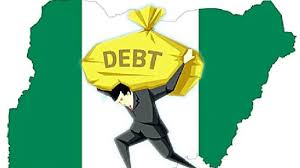
Nigeria's total public debt climbed to N159.28 trillion ($110.3 billion) as of December 31, 2025, according to data from the Debt Management Office (DMO), underscoring the country's deepening fiscal strain under President Bola Tinubu's administration.
The figure was disclosed by President Tinubu in a letter to the Senate, where he put Nigeria's total public debt at approximately $110.3 billion, equivalent to about N159.2 trillion as of December 31, 2025.
The latest figure marks a significant climb from the N153.29 trillion recorded at the end of the third quarter of 2025. That Q3 figure already represented a 0.59% increase from the N152.39 trillion posted in June 2025, pointing to a consistent, if accelerating, upward trajectory in Nigeria's debt profile through the year.
A review of the approved Medium Term Expenditure Framework for 2026 to 2028 shows that debt servicing alone is expected to gulp N54.3 trillion of Nigeria's revenue over the three years: N15.5 trillion in 2026, N19.4 trillion in 2027, and N19.4 trillion in 2028.
The World Bank has also raised an alarm over the structural impact of the debt burden. In its Nigeria Development Update for April 2026, the Bank warned that while Nigeria's debt-to-GDP ratio remains moderate by international standards, the debt service-to-revenue ratio stood at an estimated 49.5% in 2025, effectively crowding out capital spending on infrastructure and human development.
Capital execution was particularly weak, with only 24% of the prorated 2025 capital budget of ministries, departments, and agencies implemented.
Adding to near-term pressures, the Senate recently approved a fresh $6 billion external loan request from the President, which experts warn comes with significant foreign exchange risks and could worsen the federal government's debt service-to-revenue ratio, estimated at around 60% by end-2025.
Nigeria's 2026 budget projects a deficit of at least N23.85 trillion, equivalent to 4.28% of GDP, meaning borrowing pressures are unlikely to ease in the near term.
Moody's, however, struck a cautiously optimistic note, projecting Nigeria's debt burden to decline to around 35% of GDP in 2026 from an estimated 36.2% in 2025, supported by stronger revenue mobilisation from tax reforms and a more stable naira. Inflation also eased sharply, falling to 15.1% in January 2026 from nearly 27.6% a year earlier.
Nonetheless, fiscal analysts continue to stress that without a meaningful improvement in non-oil revenues and tighter control over recurrent spending, Nigeria's debt trajectory remains a long-term vulnerability.
Stay Informed: Visit our website for Breaking News, Intelligence, and Insights