
After decades of failed rehabilitation programmes and billions of dollars spent on refineries that refuse to run, Nigeria's state oil company is trying something different, bringing in partners who only profit when the refineries actually work.
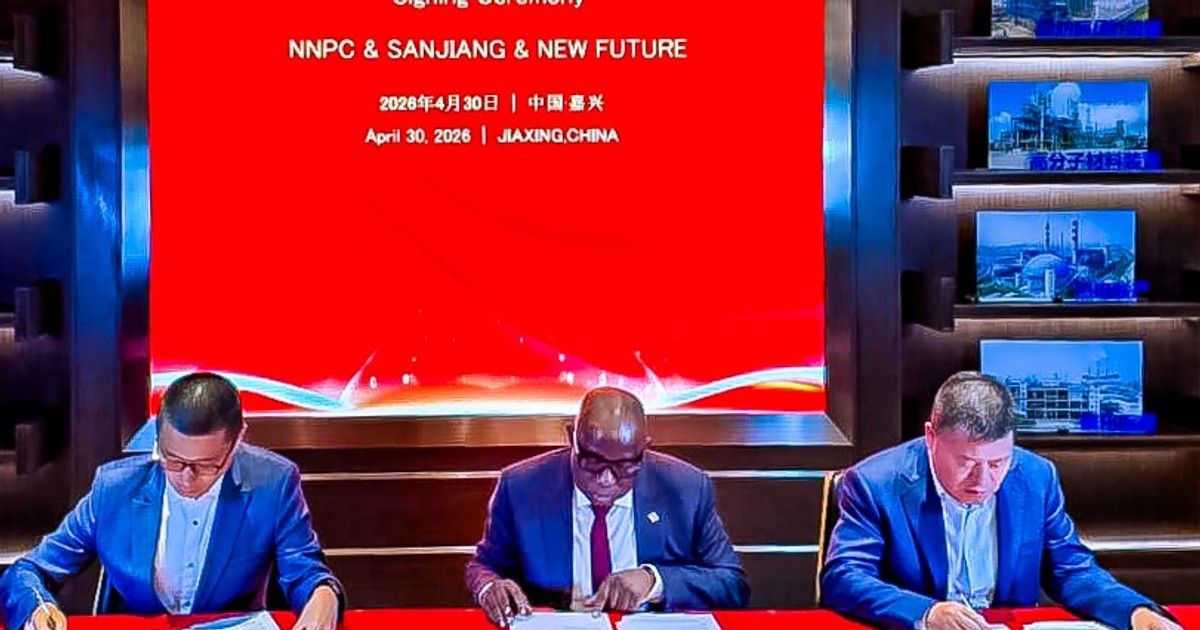
NNPC Limited has signed a Memorandum of Understanding with two Chinese companies, Sanjiang Chemical Company Limited and Xingcheng (Fuzhou) Industrial Park Operation and Management Co., Ltd., for collaboration through a potential Technical Equity Partnership in support of the completion and operation of the Port Harcourt and Warri refineries. The agreement was executed in Jiaxing City, China, on April 30, 2026, by NNPC Group Chief Executive Officer Bashir Bayo Ojulari, alongside Guan Jianzhong, Chairman of Sanjiang Chemical Company, and Bill Bi, Chairman of Xingcheng Industrial Park.
According to NNPC, the MoU sets the stage for a potential Technical Equity Partnership aimed at completing outstanding work at both facilities, ensuring their long-term operational efficiency, and developing co-located gas-based industrial hubs that could transform the Port Harcourt and Warri complexes into integrated energy and petrochemical centres.
Under the proposed partnership, the focus will also include upgrading and expanding the facilities to produce cleaner fuels and improve profitability. The scope goes beyond rehabilitation, with plans to harness gas and downstream opportunities at both sites.
The strategic logic is a direct departure from the past. Ojulari had earlier canvassed at the Nigeria International Energy Summit 2026 for global partners willing to take equity positions in Nigeria's refining assets, arguing: "What we are doing differently is moving away from just funding projects to bringing in partners who have skin in the game, partners who will operate, optimise, and guarantee performance."
The urgency behind the approach is rooted in a damaging operational history. Operations at the Warri and Port Harcourt refineries have remained largely inactive since May 24, 2025, when they were shut down for maintenance initially expected to last just 30 days. Subsequent reviews revealed deeper structural and financial challenges, and in February 2026, Ojulari disclosed that the refineries were operating at significant losses, prompting extended shutdowns to prevent further value erosion. This follows the most glaring failure of the previous era: a $1.5 billion rehabilitation of the Port Harcourt refinery that delivered no sustained operations.
Ojulari described the MoU as a significant milestone, following more than six months of concerted engagement between the technical and management teams of NNPC and the two Chinese partners.
The MoU is not yet binding; any definitive agreements remain subject to regulatory approvals and the conclusion of detailed commercial negotiations. For a country that has heard many refinery promises before, it is the delivery, not the signing, that will ultimately define this deal.
Stay Informed: Visit our website for Breaking News, Intelligence, and Insight