
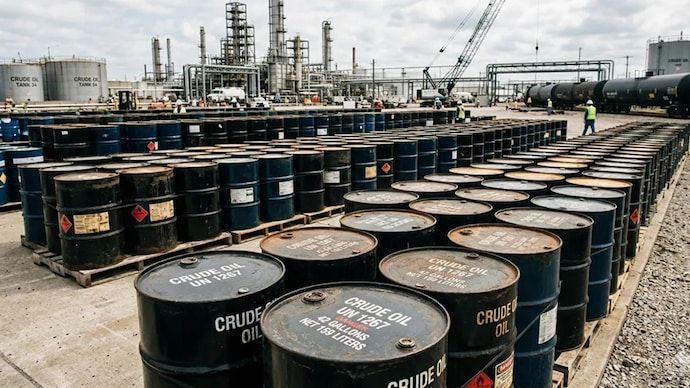
Oil prices surged past the critical $ 100-per-barrel threshold on Monday, March 9, 2026, after several Gulf producers cut output amid escalating geopolitical tensions that have disrupted supply routes across the Middle East. U.S. benchmark West Texas Intermediate (WTI) briefly approached $120 per barrel during intraday trading, marking one of the sharpest price spikes in global energy markets in years.
Trading data from ICE Futures Europe showed Brent crude surging above $100 for the first time since 2022, while WTI futures jumped more than 30 percent at the session peak, touching about $118 to $119 per barrel before stabilising slightly lower.
The surge followed production cuts and shutdowns by key Gulf exporters as the conflict around Iran intensified and shipping flows through the Strait of Hormuz, a corridor responsible for roughly 20 percent of global oil trade, slowed sharply.
Energy market analysts say the rally reflects a sudden tightening in global supply rather than a demand shock.
According to market data cited by ING commodity strategists, Iraq has already reduced output by roughly 1.5 million barrels per day, while Kuwait and the United Arab Emirates have begun trimming production as storage and export logistics tighten.
“The oil market is now pricing in a prolonged supply disruption from the Gulf,” said Warren Patterson, Head of Commodities Strategy at ING, in a market note released on Monday, March 9, 2026, in London. “With flows through the Strait of Hormuz heavily constrained, the risk premium in crude prices has expanded dramatically.”
Data compiled from global shipping trackers show tanker traffic through the Hormuz corridor dropping sharply in recent days as insurers have raised risk premiums and operators have delayed voyages.
Analysts estimate that more than 20 million barrels per day of oil and liquefied natural gas normally pass through the route, making it the most critical chokepoint in global energy trade.
The oil price spike is already reverberating across financial markets. Global equity indices declined in early Monday trading as investors rotated into energy commodities and safe-haven assets. The surge is also pushing inflation expectations higher across major economies that depend heavily on imported fuel.
For African economies, the rally presents mixed implications. Major crude exporters such as Nigeria, Angola, and Algeria stand to benefit from stronger export revenues and improved fiscal inflows.
However, many African nations import refined petroleum products, meaning that higher crude prices can quickly translate into rising fuel costs, increased logistics expenses, and inflationary pressures for small businesses.
Energy economists say the trajectory of oil prices will depend heavily on whether supply disruptions in the Gulf persist. If tanker movements remain restricted and additional producers cut output, crude prices could remain elevated across global markets in the near term.
Stay Informed: Visit our website for Breaking News and Insights.