
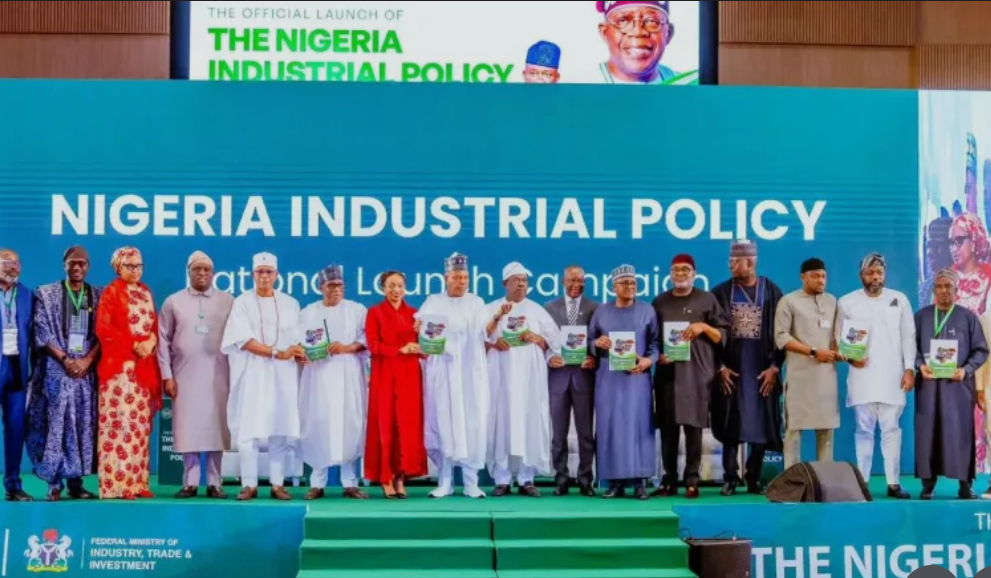
President Bola Tinubu on Tuesday formally launched the Nigeria Industrial Policy 2025, setting an ambitious course to transform Africa’s largest economy into a manufacturing powerhouse.
But even as government officials celebrated the unveiling at the Bola Ahmed Tinubu International Conference Centre in Abuja, the country’s most powerful industrialist issued a blunt reality check: without stable electricity, none of it matters.
Represented by Vice President Kashim Shettima, Tinubu described the policy as a strategic blueprint to re-engineer the country’s industrial base, unlock value across priority sectors, and shift Nigeria from exporting raw materials to producing finished goods. The administration has set a target to raise manufacturing’s contribution to GDP from the current 10–12 per cent to between 20 and 25 per cent by 2030.
“We have realized that industrialization is not a wish you think about; it is an action you perform,” Tinubu said, adding that success would be measured not by documents produced, but by “factories that open their gates at dawn, jobs created, and exports that leave our ports bearing the mark of Nigerian excellence.”
Dangote’s Warning: ‘No Power, No Growth’
Aliko Dangote, chairman of Dangote Group and Africa’s richest industrialist, used the occasion to deliver an urgent call for power sector reform. He urged the government to convene a national retreat dedicated solely to resolving Nigeria’s electricity crisis, describing reliable power as the single most critical factor for industrial success.
“One of the things that I want to advise Your Excellency, Mr. Vice President, is to call a national forum where we will have a one- or two-day retreat and resolve the issues of power,” Dangote said. “Because without power, Mr. Vice President, there is no way in any country you can create growth or create jobs. Power means growth. No power, no growth.”
Dangote’s comments came against the backdrop of a five-day nationwide blackout caused by gas supply disruptions to seven power plants between February 12 and 15. His remarks drew sustained applause from the audience, including the Vice President.
The industrialist revealed that many manufacturers now spend more on power generation than on production due to Nigeria’s unreliable grid. “Some factories spend more money generating electricity than producing goods,” he said. “You have to set up your own power plant and also a standby. That does not make sense.”
The Policy Framework
The Nigeria Industrial Policy 2025 prioritizes value chain development and integrates micro, small, and medium enterprises into mainstream industrial growth. It aligns infrastructure, energy, finance, innovation, and skills development with long-term industrial ambition. A dedicated implementation committee has been established to translate the framework into measurable productivity gains.
Officials have also tied the policy to Nigeria’s strategic position under the African Continental Free Trade Area, warning against allowing the country to become a dumping ground for imported goods. Early measures include a temporary ban on raw shea nut exports to encourage domestic processing.
While Dangote welcomed the policy and predicted the naira would stabilize at ₦1,000 to $100 by year-end, he stressed that industrial protection and reliable electricity remain non-negotiable preconditions. “If there is no protection, there is no way any industry will thrive here,” he said.
The Execution Test
Tinubu acknowledged that Nigeria has long grappled with fragmented value chains, high production costs, infrastructure gaps, and policy inconsistency. “This stops now,” he declared, insisting the policy has established a clear implementation architecture.
The President of the Manufacturers Association of Nigeria, Otunba Francis Meshioye, pledged manufacturers’ full support for implementation. The UN Resident and Humanitarian Coordinator in Nigeria, Mohamed Malick Fall, described the launch as a decisive step toward inclusive economic growth.
But analysts caution that policy coherence, cross-ministerial coordination, investor confidence, and critically, structural reforms in the power sector will determine whether the Nigeria Industrial Policy 2025 becomes a transformative milestone or another ambitious document constrained by execution gaps.
Stay Informed: Visit our website for Breaking News and Insights.