
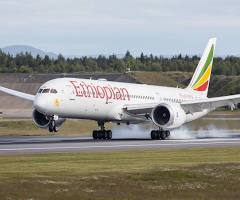
Ethiopia has officially launched the construction of a massive, multi-phased international airport near Bishoftu, a move designed to catapult the nation into the same league as global transit titans like Dubai and Doha. On January 10, 2026, Prime Minister Abiy Ahmed laid the foundation stone for the Bishoftu International Airport (BIA), a $12.5 billion mega-project situated roughly 40 kilometers southeast of Addis Ababa. This is not merely an infrastructure upgrade; it is a strategic maneuver to ensure the survival and supremacy of Ethiopian Airlines Group, the continent’s most profitable carrier, which is rapidly outgrowing its current home at Bole International Airport. While Bole International has served as a reliable gateway, it suffers from a literal glass ceiling: its elevation. At over 2,300 meters above sea level, the thin air at Bole forces long-haul aircraft to limit their takeoff weight, often requiring technical stops for fuel on routes to North America or East Asia. The new site at Bishoftu sits at a significantly lower altitude. This geographical shift is a game-changer for flight physics, allowing aircraft to carry full passenger and cargo loads with improved fuel efficiency. According to technical briefs from Dar Al-Handasah, the lead consultant on the project, this lower elevation will empower Ethiopian Airlines to operate more non-stop, ultra-long-haul flights, directly competing with Middle Eastern hubs for lucrative transit traffic. The scale of the project, designed by the world-renowned Zaha Hadid Architects, is staggering. The vision extends beyond runways to a comprehensive “Airport City” that will include: Four parallel runways and a 1.1 million-square-meter terminal. Integrated hotels, shopping malls, industrial parks, and dedicated Maintenance, Repair, and Overhaul (MRO) facilities. In a climate of global economic tightening, the $12.5 billion price tag has raised eyebrows. However, Ethiopian Airlines CEO Mesfin Tasew has clarified a robust 30/70 funding split. The airline is self-funding 30% of the costs, having already allocated $610 million for initial earthworks, while the remaining 70% will be covered by international lenders. The African Development Bank (AfDB) has emerged as a cornerstone partner, pledging $500 million and serving as the lead arranger to attract another $8.7 billion from a consortium of investors. Interest has already been signaled from financiers in the Middle East, China, Europe, and the United States. > “Bishoftu International Airport marks a historic leap in Africa's aviation journey," stated Mesfin Tasew during the groundbreaking. “It positions Ethiopia to become the aviation capital. The project is not without its critics or challenges. Local reports indicate that approximately 15,000 residents may be displaced by the 35-square-kilometer site, prompting ongoing discussions on compensation and resettlement.
Furthermore, Ethiopia continues to navigate a complex domestic political landscape and foreign-currency shortages, which could affect the procurement of specialized aviation technology. Strategically, the airport is a direct challenge to the “Big Three” Gulf carriers. By positioning itself at the crossroads of Africa, Europe, and Asia, Ethiopia is betting that a more efficient, modern hub can siphon off the transit traffic currently routed through Dubai (DXB) and Istanbul (IST). The success of the Bishoftu project is inextricably linked to the African Continental Free Trade Area (AfCFTA). As trade barriers fall, the demand for air freight is expected to surge by 28%. With its planned 3-million-ton cargo capacity, Bishoftu is being built to serve as the primary logistics engine for the entire continent. For investors and industry observers, the timeline is tight. Earthworks are slated for completion within a year, with main contractors expected to begin structural work in August 2026. If Ethiopia hits its 2030 opening target for Phase One, the center of gravity for global aviation may very well shift toward the Horn of Africa.
Stay Informed: Visit our website for Breaking News and Insights.