
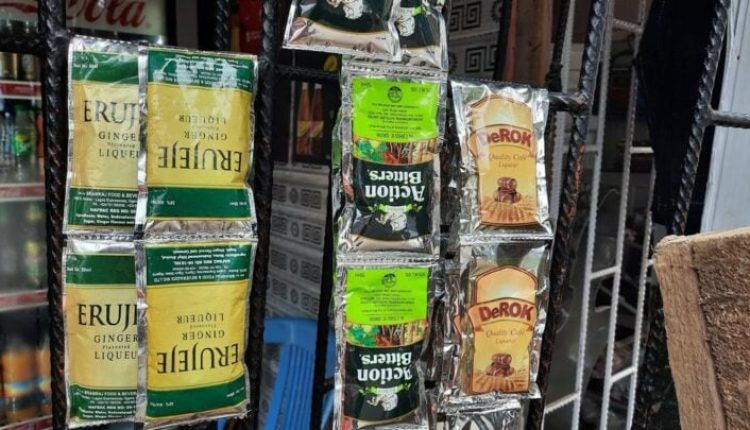
The Federal Government on Tuesday launched a coordinated nationwide enforcement campaign to eliminate sachet alcohol from Nigerian markets, deploying three regulatory agencies to crack down on producers, distributors, and retailers selling alcohol in sachets and bottles smaller than 200 millilitres.
The campaign, flagged off at the National Orientation Agency headquarters in Abuja, brings together NAFDAC, NOA, and the Federal Competition and Consumer Protection Commission following alarming findings from a 2021 national survey showing that 54.3 per cent of minors obtain alcohol independently, with nearly half purchasing from retailers selling sachets and small bottles that are easy to conceal.
The survey, conducted across six states with 1,788 respondents, found children as young as nine consuming alcohol, with 47.2 per cent of minors obtaining drinks in sachets specifically because they are easy to hide. Sachet alcohol often contains up to 50 per cent alcohol by volume compared to beer’s typical six to eight per cent, making it exponentially more dangerous for developing brains.
The ban took effect on January 1, 2026, but enforcement has been delayed for years. In 2018, industry groups approached NAFDAC seeking reduced alcohol concentration levels. Then-Minister of Health Isaac Adewole granted a five-year moratorium, which expired in February 2024. Further delays followed until the Senate passed resolutions in November 2025, urging NAFDAC not to grant further extensions and directing immediate strict enforcement.
NAFDAC Director-General Professor Mojisola Adeyeye described the data as a public health crisis. “Excessive alcohol intake among minors is linked to road crashes, risky behaviour, poor academic performance, and long-term damage to parts of the brain responsible for memory, learning, and self-control,” she said.
NOA will deploy its 818 offices across all 774 local government areas to lead behavioural change and public sensitisation. Community officers will engage youth groups, transport unions, market associations, schools, and faith-based organisations in local languages. Citizens can report violations through the NOA CLHEEAN App.
NAFDAC will handle regulatory enforcement, while FCCPC ensures compliance with consumer protection regulations. FCCPC Director of Corporate Affairs Ondaje Ijagwu warned that sanctions will be severe. “By the time we begin implementation, Nigerians will know,” he said.
Professor Adeyeye also debunked fake reports circulating on social media claiming the National Assembly had called for a suspension of the ban. “The Senate resolutions urge NAFDAC not to grant further extension to the moratorium and to ensure immediate strict enforcement. These claims are categorically false,” she said.
NOA Director-General Lanre Issa-Onilu emphasised the urgency. “For too long, sachet alcohol has been dangerously accessible. Protecting our children today is an investment in Nigeria’s stability and productivity tomorrow,” he said.
With regulatory enforcement, consumer protection, and nationwide sensitisation now aligned, the Federal Government is signalling that the era of sachet alcohol in Nigeria has ended and violators should expect firm consequences.
Stay Informed: Visit our website for Breaking News and Insights.