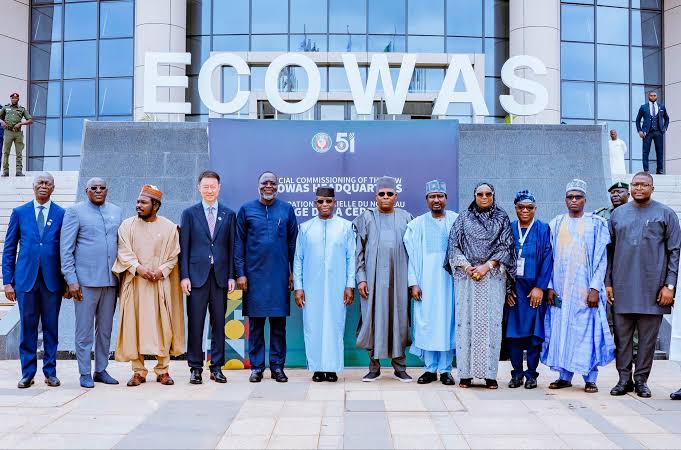
President Bola Tinubu has used the commissioning of the new ECOWAS headquarters in Abuja to issue a pointed challenge to West African leaders, calling on the bloc to abandon its role as a passive market for imported goods and reinvent itself as a production-driven regional economy capable of meeting its own needs.
Represented by Vice President Kashim Shettima at the commissioning of the new complex, dubbed the "Eye of Africa," Tinubu said the new facility should serve as a symbol of renewed commitment to regional integration, peace, industrialisation and shared prosperity across West Africa.
His remarks were direct. "The hour has come to transform our regional market into a regional production base. Our integration must increasingly be driven by what we produce rather than by what we consume, for a community that consumes what it does not make will forever live at the mercy of the goodwill of others," he said.
He stressed that deeper industrialisation, stronger regional value chains, expanded intra-African trade, innovation, manufacturing and investment must shape the next phase of ECOWAS, arguing that the bloc's integration agenda must now translate into concrete economic transformation rather than declarations.
Tinubu acknowledged ECOWAS' achievements in peace-building, democratic governance, economic cooperation and the free movement of people, goods and services, but warned the region must urgently confront terrorism, violent extremism, economic vulnerability, food insecurity, climate change and the expectations of a growing youthful population.
The commissioning ceremony carried an unmistakable geopolitical subtext. The new ECOWAS complex was financed by the Government of the People's Republic of China and constructed by Shaanxi Construction Engineering Group Company Limited. China's Ambassador to Nigeria and ECOWAS, Yu Dunhai, described the inauguration as another milestone in China's commitment to Africa's integration, adding that the future of the relationship would rest on mutual trust and cooperation that enable Africa to independently determine its own development pathways.
Tinubu also addressed the recent withdrawal of three member states from the bloc, saying the development has shown that integration can no longer be viewed only through an economic lens. "Regional integration can no longer be an economic imperative alone. It has become a comprehensive framework for our collective security, our political stability, our sustainable development, and the welfare of our peoples," he said. He added that ECOWAS must keep its doors open to the departing countries and called for renewed dialogue.
Sierra Leone's President Julius Maada Bio, Chairman of the ECOWAS Authority of Heads of State and Government, praised Nigeria as "a great anchor" of the West African bloc and described the new headquarters as an opportunity for member states to renew their collective promise to the more than 450 million people of West Africa.
The speech Tinubu delivered through Shettima was the kind of address that reads better than it lands. A region that produces what it consumes is a compelling vision. Whether ECOWAS, which has spent five decades falling short of its own integration targets and just lost three members to a rival alliance, has the institutional coherence to pursue it is an entirely different question, and one the inauguration of an impressive building does not answer.
Stay Informed: Visit our website for Breaking News, Intelligence, and Insight.