
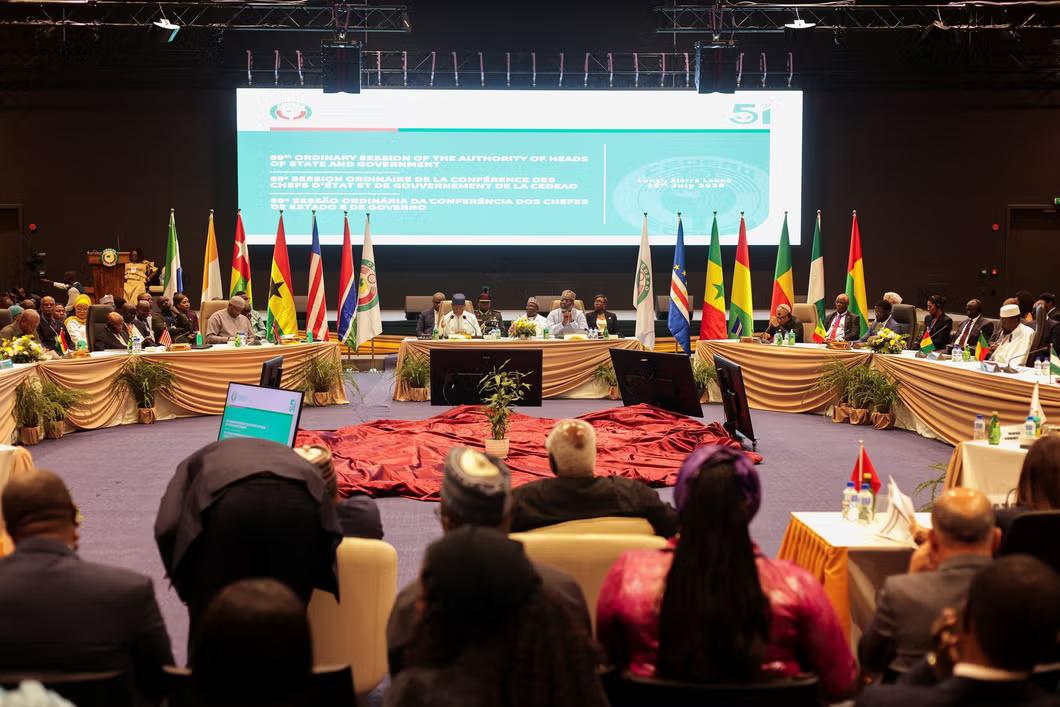
ECOWAS heads of state and government signed the Intergovernmental Agreement governing the Nigeria-Morocco African Atlantic Gas Pipeline on Sunday in Freetown, Sierra Leone, formalising the bloc's collective endorsement of one of the most ambitious energy infrastructure projects ever attempted on the African continent and clearing the way for the $25 billion corridor to enter its operational development phase.
The agreement covers a strategic 6,800-kilometre pipeline designed to carry Nigerian natural gas along Africa's Atlantic coast to Morocco, with a planned onward connection to Europe's gas network. The pipeline will cross 13 countries along the Atlantic coast before connecting to the Maghreb-Europe gas pipeline in northern Morocco, with a transport capacity of 30 billion cubic metres of natural gas per year, of which up to 15 billion cubic metres could be exported to Morocco and Europe, with the remainder supplying regional West African markets.
The project is jointly developed by Morocco's National Office of Hydrocarbons and Mines (ONHYM) and NNPC Limited and was originally launched as a bilateral initiative by King Mohammed VI of Morocco and the late former Nigerian President Muhammadu Buhari in 2016 before receiving continued support from President Bola Tinubu. ONHYM and NNPC confirmed that the main technical, environmental, and engineering studies have been completed, which will allow the project to gradually enter its operational development phase following Sunday's signing.
The commissioning of the first pipeline segments is expected at the beginning of the next decade, with early sections connecting Morocco to offshore gas developments in Mauritania and Senegal before extending south through Ghana, Côte d'Ivoire, and the remaining participating states to Nigeria.
The strategic logic of the pipeline is layered. For Nigeria, it offers the most credible path yet to monetising the world's largest undeveloped gas reserves at scale. For Morocco, it cements Rabat's stated ambition to become the primary energy gateway between Africa and Europe. For the West African states in between, it promises electricity generation capacity, industrial feedgas, and the infrastructure underpinning a regional energy market that has existed in policy documents for decades but never in pipelines.
The obstacles, however, are as large as the ambition. Securing $25 billion in capital from increasingly environment-conscious lenders remains the project's most significant financing challenge, while the pipeline's coastal route spans jurisdictions that struggle with political instability, maritime piracy and localised infrastructure risks, demanding a level of long-term security cooperation among participating nations that has rarely been achieved in the region.
The Freetown signing does not resolve those questions. What it does is transform the Nigeria-Morocco pipeline from a bilateral aspiration backed by feasibility studies into a treaty-level commitment backed by every ECOWAS head of state. That is not a small thing, even if the harder work, raising the money, building across 13 countries, and keeping the gas flowing through a decade of political change, still lies entirely ahead.
Stay Informed: Visit our website for Breaking News, Intelligence, and Insight.